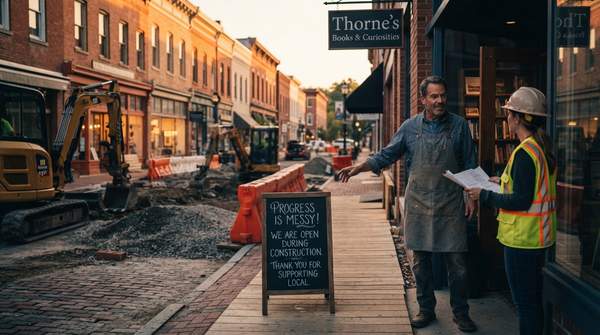
While many towns close Main Street for a single Fall Festival, the Alleghany Highlands saw $69 million in tourism spending in 2023. This success stems not from fleeting events, but from deep, sustained community-led planning. This remarkable figure, representing visitor spending, proves the power of long-term vision over temporary spectacle in achieving Main Street revival.
Yet, I observe many communities attempt revitalization through popular, short-term events. Genuine and lasting economic resilience, however, demands deep, continuous community engagement and strategic, long-term infrastructural development. This tension between immediate gratification and enduring progress defines the challenge facing our local economies.
I argue that communities prioritizing comprehensive, locally-driven strategies, supported by external expertise and sustained engagement, are more likely to build enduring economic vitality than those relying on temporary attractions.
My perspective is clear: the Alleghany Highlands' $69 million tourism success in 2023 was a deliberate choice. It prioritized sustained, university-backed community planning and foundational infrastructure like high-speed broadband over fleeting festivals. This decision sets it apart from towns pursuing episodic efforts. Communities attempting Main Street revitalization through isolated events fundamentally misallocate resources, chasing temporary crowds while neglecting the deeper investments required for lasting economic impact. The true measure of success lies not in a single day's festivities, but in the enduring infrastructure and robust community fabric built over years.
Beyond the Festival: Building a Foundation for Growth
In 2023, tourism generated a remarkable $69 million in visitor spending in the Alleghany Highlands, according to Virginia Tech News. This financial success is no accident; it is deeply intertwined with foundational developments. High-speed broadband now reaches over 95 percent of the area, as also reported by Virginia Tech News, transforming connectivity from a luxury to a fundamental economic driver. Integrated efforts extend to housing, with a regional housing summit exploring new development and reinvestment in existing stock, including adaptive reuse of former school buildings. Such comprehensive planning and investment in critical infrastructure, far beyond mere events, actively cultivates a robust and resilient foundation for long-term community revival. It signals a commitment to future prosperity that transcends seasonal celebrations.

The Lure of the Quick Fix
I understand the allure of simplicity, the immediate vibrancy created by closing Main Street for a single Fall Festival, as promoted by the Alleghany Chamber. Such events draw crowds and offer a burst of activity. However, these popular, short-term attractions often mask the lack of underlying structural improvements and sustained community buy-in needed for true, lasting economic health. Communities that rely solely on such superficial, event-based revitalization efforts miss opportunities for sustained growth, failing to address the deeper systemic needs of their local economies.
The Architecture of Engagement: How Local Ownership is Built
True community engagement is not an accident; it requires deliberate structures and strategic partnerships. Virginia Tech's Center for Economic and Community Engagement provides university expertise, supporting locally driven planning and decision-making in the Alleghany Highlands, according to Virginia Tech News. The Alleghany Foundation reinforces this model, convening its grantees to disseminate and solicit ideas from community members, as detailed by the Alleghany Foundation. The Foundation even engaged a local educator as a consultant to foster deeper conversations with school systems, actively integrating diverse local voices. This commitment, evidenced by engaging local experts and requiring grantees to describe community engagement, proves 'community-led' development is not passive. It demands active, expert facilitation and a funding ecosystem that explicitly prioritizes and measures genuine local involvement, transforming local input into tangible progress.
A Blueprint for Lasting Prosperity
For communities seeking genuine and lasting revitalization, the Alleghany Highlands offers a clear blueprint. Grant applicants to the Alleghany Foundation are specifically asked to describe how they have engaged the community in their work, according to the Alleghany Foundation. This systemic approach, where community engagement is a prerequisite for support, proves that sustainable revitalization hinges on embedding local ownership and participation as a fundamental principle, ensuring projects are relevant and supported. My conviction is that modern rural revitalization is less about nostalgic charm and more about adopting a forward-thinking, digitally-integrated strategy that attracts both visitors and new residents, driven by university expertise and robust broadband coverage. By Q3 2026, communities that have not adopted this comprehensive, engagement-first model will likely find their Main Streets struggling to compete with regions like the Alleghany Highlands, which continues to build on its $69 million tourism success.