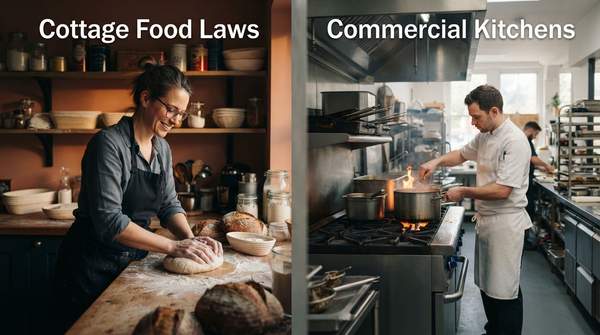
For home-based food entrepreneurs, understanding the regulatory landscape is crucial for scaling a business locally. The primary distinction lies between operating under cottage food laws and requiring a commercial kitchen, each with its own set of legal frameworks and operational requirements. This guide helps entrepreneurs identify which category their food product and business model likely fall into, outlines general permit and certification needs, and directs where to seek specific state and local guidance.
Understanding the Regulatory Landscape for Home-Based Food Businesses
Operating a food business from home involves navigating a complex web of regulations that span federal, state, and local jurisdictions. While the U.S. Food and Drug Administration (FDA) oversees food safety for products in interstate commerce and certain high-risk categories, the primary regulation for retail and home-based food businesses typically falls to state and local authorities. These local health departments are responsible for issuing licenses or permits for food prepared and sold directly to consumers.
The Association of Food and Drug Officials (AFDO) highlights that state-specific laws and guidance for cottage food production cover various aspects, including licensing, food safety regulations, labeling requirements, and permissible homemade food products. For instance, the Virginia Department of Agriculture and Consumer Services (VDACS) notes that food establishments, including private homes that manufacture, process, pack, or hold food for sale, are subject to the Virginia Food and Drink Law and related regulations. This multi-layered approach means that while general principles apply, specific requirements can vary significantly depending on where an entrepreneur operates.
Cottage Food Operations: Criteria and Common Requirements
Cottage food operations generally allow individuals to produce certain low-risk foods in an unlicensed home kitchen for sale directly to consumers. These operations are typically exempt from the more stringent requirements of commercial food establishments, though specific criteria vary by state. For example, Florida law permits individuals to use their unlicensed home kitchens to produce and sell certain foods that pose a low risk of foodborne illness, without needing a food permit from the Florida Department of Agriculture and Consumer Services.
Common characteristics and requirements for cottage food operations include:
- Permissible Products: Generally limited to non-potentially hazardous foods that do not require refrigeration for safety. Examples often include baked goods, jams, jellies, candies, and certain confections. The California Department of Public Health (CDPH) maintains an approved list of such foods.
- Sales Limits: Most states impose annual gross sales limits. For instance, Texas updated its annual gross income threshold to $150,000 for cottage food production operations, while Oregon's annual sales limit is $51,200 as of 2025, with annual adjustments. Florida's gross sales for a cottage food operation must not exceed $250,000 annually. Exceeding these limits typically necessitates transitioning to a commercial operation.
- Operational Rules: Food must be prepared in a private home kitchen that is maintained in a clean and sanitary manner. While home kitchens are generally unlicensed and not subject to routine inspections, they may be inspected if a complaint is filed. Some states, like Massachusetts, allow a designated agent to sell and deliver homemade products on behalf of a producer, and permit sales at direct-to-sale farmers markets.
- Registration/Permitting: While some states, like California, do not directly permit or register cottage food operations at the state level, they may require registration with local environmental health departments. The District of Columbia requires submitting a Cottage Food Registry Application to DC Health, and a pre-operational inspection may be necessary. Illinois requires registration with the local health department where the entrepreneur resides.
When a Commercial Kitchen is Required: Product and Scale Triggers
Certain food products and business models inherently require a commercial kitchen due to higher food safety risks or the scale of operation. The U.S. Food and Drug Administration (FDA) specifies that foods such as low-acid canned foods, milk, eggs, juices, seafood, and infant formula have additional product-specific regulatory requirements to ensure they are healthful and free of contamination. These products typically necessitate a commercial, inspected facility.
Key triggers that often require a commercial kitchen include:
- Potentially Hazardous Foods: Any food that requires time or temperature control for safety (TCS foods) to prevent the growth of harmful microorganisms. This includes products containing meat, poultry, seafood, dairy, cooked vegetables, or cut fruits. Texas, for example, states that TCS foods are not eligible for donation by cottage food operations.
- Specialized Processing: Products like low-acid canned foods, acidified foods (e.g., pickles, salsas), and fermented foods often have additional requirements for food safety due to their potential to harbor dangerous bacteria if not processed correctly. The Illinois Department of Public Health (IDPH) notes that canned tomatoes, acidified, and fermented foods have additional safety requirements. Colorado specifically prohibits freeze-dried meals and products containing CBD or THC under its cottage food regulations.
- Exceeding Sales Limits: As mentioned, once a cottage food operation surpasses its state's annual gross sales limit, it typically must transition to a licensed commercial facility.
- Wholesale or Broader Distribution: While some cottage food laws are expanding to allow wholesale, many still restrict sales to direct-to-consumer channels. For instance, the District of Columbia's 2025 amendment allows Cottage Food Businesses to sell wholesale to licensed food establishments, but this is a specific regulatory update. Generally, if an entrepreneur plans to sell to restaurants, grocery stores, or through online platforms with shipping across state lines, a commercial kitchen and associated permits are usually required.
Decision Framework: Cottage Food vs. Commercial Kitchen
Entrepreneurs can use this framework to systematically evaluate their food product and business model against common regulatory criteria, quickly identifying whether they likely fall under cottage food laws or require a commercial kitchen.
| Dimension | Cottage Food Operations | Commercial Kitchens |
|---|---|---|
| Regulatory Scope | Primarily regulated by state and local authorities, with federal oversight for interstate commerce or specific high-risk foods. Regulations vary significantly by state and locality. | Subject to more stringent federal, state, and local regulations, including facility inspections and specific food safety plans. Required for products not eligible for cottage food laws or for operations exceeding cottage food limits. |
| Product Eligibility | Generally limited to non-potentially hazardous foods that do not require refrigeration for safety, such as baked goods, jams, jellies, and certain confections. Specific permissible food lists vary by state; potentially hazardous foods are typically excluded. | Required for potentially hazardous foods, low-acid canned foods, acidified foods, milk, seafood, meat, and other products requiring specialized processing or temperature control. These products pose higher foodborne illness risks and necessitate controlled environments. |
| Sales Limits | Subject to annual gross sales limits, which vary significantly by state (e.g., $50,000 in Florida, $80,000 in California, $150,000 in Texas). Exceeding these limits typically requires transitioning to a commercial operation. | No specific sales limits imposed by "cottage food" definitions; sales capacity is limited by facility size and operational permits. |
| Operational Requirements | Food must be prepared in a private home kitchen that is clean and sanitary, often with restrictions on sales channels (e.g., direct to consumer). Home kitchens are generally unlicensed and not subject to routine inspections, but may be inspected upon complaint. | Requires a dedicated, inspected facility that meets specific health and safety codes, allowing for broader sales channels including wholesale. These facilities are subject to regular inspections by health authorities. |
| Permits/Certifications | Cottage food operations may require registration or a permit (e.g., DC, Illinois), while commercial kitchens require a food manufacturer permit and often a certified food protection manager. Specific requirements, including food safety training, vary by state and local jurisdiction. | Typically requires a food manufacturer permit, business license, and often a Certified Food Protection Manager (CFPM) on staff. |
Key Permits and Certifications for Food Businesses
Regardless of whether an operation falls under cottage food laws or requires a commercial kitchen, entrepreneurs will encounter various permits, registrations, and certifications. These requirements are designed to ensure public health and safety.
- Business Registration/License: Most businesses, including home-based food operations, need to register with their state and local government. This might include obtaining a general business license or registering a business name.
- Cottage Food Registration/Permit: For cottage food operations, some states or local jurisdictions require a specific registration or permit. For example, the District of Columbia Department of Health requires a Cottage Food Registry Application. Illinois also mandates registration with the local health department.
- Home Occupancy Permit: If operating from a private residence, a home occupancy permit from the local department of buildings may be required, as noted by the District of Columbia Department of Health.
- Food Manufacturer Permit: Commercial kitchens and food manufacturing facilities typically require a food manufacturer permit from the state's department of agriculture or health. The Virginia Department of Agriculture and Consumer Services provides a permit application for food manufacturers.
- Certified Food Protection Manager (CFPM): Many jurisdictions, especially for commercial operations, require at least one individual to hold a Certified Food Protection Manager certification. The District of Columbia Department of Health, for instance, requires a CFPM certification and a DC-Issued Certified Protection Manager ID-Card.
- Food Safety Training: While not always a formal certification, many states recommend or require basic food safety training for cottage food operators.
- Labeling Compliance: All food products, whether from a cottage food operation or a commercial kitchen, must comply with federal and state labeling regulations, including allergen declarations. The FDA provides guidance on labeling regulations.
Navigating State and Local Specifics
Given the significant variation in regulations, home-based food entrepreneurs must consult their specific state and local authorities for precise, up-to-date information. The U.S. Food and Drug Administration (FDA) advises contacting your local health department to determine state and local law requirements, as these offices issue licenses or permits for food prepared and sold to consumers.
Resources like the Association of Food and Drug Officials (AFDO) provide detailed state-specific laws and guidance for cottage food production, covering topics such as licensing, food safety regulations, labeling requirements, and permissible homemade food products. For example, the Illinois Department of Public Health (IDPH) directs entrepreneurs to contact their local health department or the IDPH food program to learn more about cottage food requirements. Similarly, the California Department of Public Health (CDPH) advises contacting local Environmental Health Departments for questions or when applying for registration or permitting of a Cottage Food Operation.
Entrepreneurs should specifically look for their state's Department of Health or Department of Agriculture websites, which often host dedicated sections for cottage food laws, food manufacturing, and permit applications. These official sources will provide the most accurate information regarding permissible products, sales limits, labeling rules, and the application process for permits and certifications in their specific jurisdiction.
Your Next Steps: Identifying Your Operational Path
Entrepreneurs should use the provided decision framework to determine their operational category (cottage food vs. commercial kitchen) and identify the initial permits/certifications required. Entrepreneurs will have identified their operational category (cottage food or commercial kitchen) and the primary permits/certifications needed by consulting their state's official health department website, based on the framework.
Sources
- How to Start a Food Business — U.S. Food and Drug Administration
- Cottage Food Regulatory Guidance – Association of Food and Drug Officials
- Home and Commercial Kitchen-Based Businesses and Food Service Vendors — VDACS
- Cottage Foods - Florida Department of Agriculture & Consumer Services — FDACS
- CDPH
- Texas Cottage Food Production — DSHS
- Oregon’s Cottage Food Exemption — OSU Extension Service
- Facebook post
- Cottage Food Businesses — Dchealth
- Cottage Food — Illinois DOIT PROD IDPH
- CDPHE